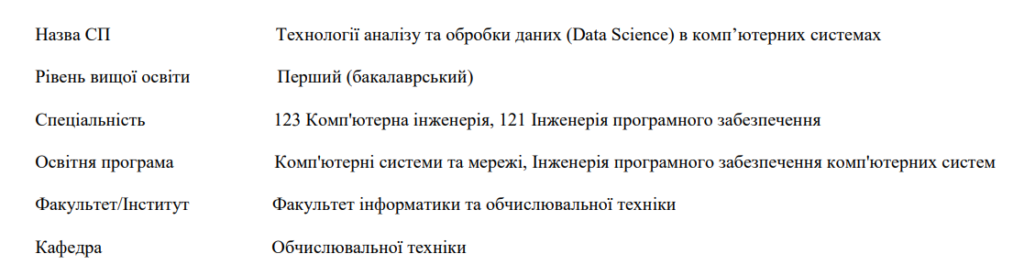
Certificate Program “Data Science Technologies for Data Analysis and Processing in Computer Systems” for the first (Bachelor’s) level of higher education under the Educational and Professional Program “Computer Systems and Networks” in specialty 123 “Computer Engineering.” Order number NОН/257/2022 dated 19.09.2022.
BRIEF DESCRIPTION OF THE CERTIFICATE PROGRAM
Annotations to the disciplines of the certificate program
Purpose of the certificate program
Relevance of launching the certificate program
Uniqueness of the certificate program
List of educational components of the certificate program
Purpose of the certificate program
The certificate program “Data Science Technologies for Data Analysis and Processing in Computer Systems” aims to provide a comprehensive and solid theoretical foundation as well as strong practical skills in software implementation of methods, mathematical models, and algorithms for Data Science technological processes, using Machine Learning and Artificial Intelligence methodologies and technologies in the fields of: Computer Vision; Time Series analysis and processing; and Natural Language Processing (NLP). The focus of the certificate program is on fundamental and applied aspects required for the following positions: Data Scientist, Data Engineer, Computer Vision Engineer, Data Analyst, Machine Learning Engineer.
Relevance of launching the certificate program
Current realities convincingly demonstrate the priority of developing high-tech systems and complexes for various purposes. In particular, this concerns the fields of security and defense, manufacturing enterprises, logistics, telecommunications, medicine, agriculture, electronic commerce, and others. The foundation of such systems and processes consists of methodologies and technologies for data acquisition, storage, and processing up to the level of information and local knowledge. This is implemented through complex hardware and software systems with the integration of computer systems. In this context, the certificate program “Data Science Technologies for Data Analysis and Processing in Computer Systems,” which covers trending applied domains of Machine Learning and Artificial Intelligence in the fields of Computer Vision, Time Series analysis and processing, and Natural Language Processing (NLP), is relevant, essential, and timely.
The certificate program is aimed at the first (Bachelor’s) level of higher education in the specialties: 121 “Software Engineering” and 123 “Computer Engineering.”
The content of the certificate program “Data Science Technologies for Data Analysis and Processing in Computer Systems” corresponds to and supports the development of priority directions of science and technology in Ukraine, including modern information and communication technologies and robotics: artificial intelligence systems, cyber-physical systems, the Internet of Things, deep learning, big data, neural networks, and intelligent interactive information-analytical systems (https://zakon.rada.gov.ua/laws/show/3534-20#Text https://zakon.rada.gov.ua/laws/show/942-2011-%D0%BF#n15 https://zakon.rada.gov.ua/laws/show/1056-2016-%D0%BF#n12).
Uniqueness of the certificate program
The specificity and uniqueness of the certificate program lie primarily in the inclusion, alongside classical Data Science methodologies, of advanced proprietary developments obtained through applied R&D projects and scientific research.
The program has a strong applied orientation and is designed to meet the needs of the IT market, thanks to cooperation with leading Ukrainian IT companies.
The educational process within the certificate program, as well as its methodological support, is based on a reasonable and well-balanced combination of theory and practice, delivered by a team of professionals.
Lecture sessions cover the theoretical foundations of key Data Science domains, their practical implementation in programming code, and are complemented by laboratory work and computer-based practical tasks.
The practical part of the course is focused on the use of the high-level programming language Python, mastering the functionality of libraries such as NumPy, Pandas, Statsmodels, Random, SciPy, Google OR-Tools, Scikit-learn, TensorFlow, Keras, Requests, Regex, OpenCV, Pillow, Matplotlib, GeoPandas, and many others. Laboratory and practical assignments are structured by levels of difficulty and designed according to the principle of increasing functionality within each topic.
The course content consistently reveals the essence of Data Science technological processes: data processing for information extraction – information processing for knowledge discovery – knowledge manipulation – result visualization.
The certificate program is supported and implemented in cooperation with the IT company Sigma Software (https://sigma.software/) and Sigma Software University (https://university.sigma.software/).
The program is carried out within the framework of the research project “Nonlinear and Multi-Criteria Mathematical Models for Data Science and Embedded Systems Technologies” (State Registration Number: 0124U003323). This enables continuous updating and modification of educational programs and components through the integration of research results into the educational process, as well as the updating of topics for qualification works, master’s theses, and doctoral research. This fully complies with accreditation requirements for educational programs.
The certificate program is designed for specialists who aim to acquire knowledge, skills, and competencies required for positions such as Data Scientist, Data Engineer, Computer Vision Engineer, Data Analyst, Machine Learning Engineer – creating and hearing the symphonies of numbers.
The certificate program includes five interconnected educational components from the elective course block:
1. Fundamentals of Data Science;
2. Data Science Technologies;
3. Computer Vision Technologies;
4. Time Series Analysis and Processing;
5. Natural Language Processing (NLP);
Each educational component enhances and deepens students’ expertise in the field of Data Science.
Statistics of student enrollment and teaching experience in the Data Science course block have demonstrated its popularity and high demand among students, which makes the certificate program “Data Science Technologies for Data Analysis and Processing in Computer Systems” highly relevant from the perspective of key stakeholders – students.
The structure of the certificate program is organized by semesters with the allocation of educational components as specified in the table.

Resource potential
Classes within the certificate program are planned to be conducted in the current classrooms of the faculty-wide facilities fund and in the laboratories of the Department of Computer Engineering, in particular with the involvement of: 537-18 Data Science Laboratory, 536-18 Artificial Intelligence Laboratory, and 501-18 Data Processing Center. The resources of the FIOT Hub are also planned to be utilized.
For implementing data processing workflows, open-source software for Python will be used: https://www.python.org/ https://www.jetbrains.com https://www.jetbrains.com/products/#lang=python https://www.jetbrains.com/help/ https://code.visualstudio.com/ https://jupyter.org/ https://colab.research.google.com/, as well as libraries from the global repository https://pypi.org/, version control systems available via https://pypi.org/ and others.
The educational and methodological complexes of the program components (department publications authored by program lecturers, electronic textbooks, lecture materials, laboratory and computer practical assignments, and assessment tasks) are fully diversified to support both offline and online delivery in synchronous and asynchronous distance learning modes (including recorded sessions). This is implemented using all available technologies and solutions. For student support in distance learning, the “Electronic Campus” platform (https://ecampus.kpi.ua), nd the Sikorsky Distance Learning Platform (https://www.sikorsky-distance.org/) are used. The Department of Computer Engineering has a powerful data processing center where educational materials are stored to support the online learning process (https://cloud.comsys.kpi.ua). For remote interaction among participants in the educational process, the department operates its own video conferencing system that provides recording and storage of lecture materials (https://bbb.comsys.kpi.ua/b).
Learning materials of the methodological support complex are hosted on: https://ecampus.kpi.ua, https://www.sikorsky-distance.org/, https://drive.google.com. Distance learning sessions and the storage of recorded lectures, laboratory/practical, and assessment classes are supported by platforms such as https://bbb.comsys.kpi.ua/b, https://zoom.us/. Communication with students is carried out via email and widely used messaging platforms. Attendance and academic performance tracking are managed through the university-wide platform https://ecampus.kpi.ua.
At least five electronic textbooks are available and hosted in the KPI library system https://opac.kpi.ua https://ela.kpi.ua/home containing the necessary theoretical and practical material—both foundational and specific to the respective certificate program disciplines.
The staffing potential of the department for delivering the program fully complies with the Licensing Conditions for educational activities. The teaching staff responsible for the certificate program components includes:
Oleksii PYSARCHUK, Doctor of Technical Sciences, Professor, Professor of the Department of Computer Engineering;
Mykhailo NOVOTARSKYI, Doctor of Technical Sciences, Professor, Acting Head of the Department of Computer Engineering;
Danylo BARAN, Assistant at the Department of Computer Engineering – PhD student (3rd year), with dissertation defense scheduled for 2025.
All lecturers of the certificate program are full-time staff members of the Department of Computer Engineering, with extensive teaching experience in “Computer Engineering” and “Software Engineering.” They are authors of textbooks, monographs, and other methodological publications, have published scientific papers in the field of Data Science in peer-reviewed international journals indexed in global databases, participate in research projects related to the program disciplines, and have practical experience applying Data Science technologies in real-world projects.
In addition, specialists from the IT partner company Sigma Software (https://sigma.software/) and Sigma Software University (https://university.sigma.software/) are planned to be involved (upon agreement) in teaching program components through guest lectures and expert presentations.
Developers
Oleksii PYSARCHUK, Doctor of Technical Sciences, Professor, Professor of the Department of Computer Engineering;
Mykhailo NOVOTARSKYI, Doctor of Technical Sciences, Professor, Acting Head of the Department of Computer Engineering;
Danylo BARAN, Assistant at the Department of Computer Engineering;
Maxym POCHEBUT, Ph.D., Associate Professor, Chief Learning Officer at Sigma Software;
Volodymyr YANTCOV, L&D Program Manager at Sigma Software.
List of educational components of the certificate program