The pedagogical school of the department was finally established and solidified between 1970 and 1980, gaining wide recognition not only in our country but also in 12 countries around the world. The school is represented not only by the faculty of the Department of Computer Engineering at NTUU “KPI” but also by the teams of four “subsidiary” departments that branched out from it (“CEIER,” “Applied Mathematics,” “Specialized Computers,” and the Computer Engineering department of the Chernihiv branch), as well as the KPI Computing Center. In Bulgaria, the school is represented by departments in the cities of Ruse, Gabrovo, and Veliko Tarnovo. Graduates of the department work as professors at several universities in Poland, Bulgaria, China, Algeria, Tunisia, Lebanon, Cuba, Germany, Jordan, Morocco, and other countries.
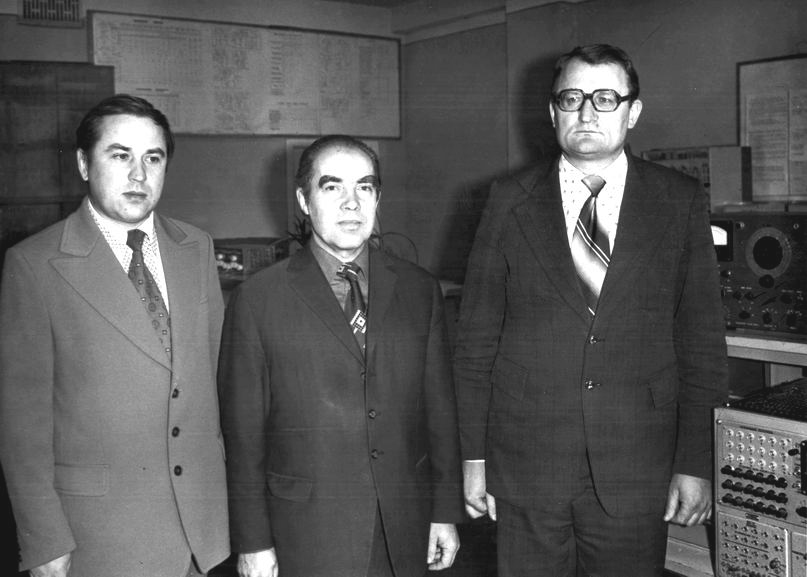
1978 р. Winners of the first “KPI” prize for the textbook “Electronic Digital Computers” (Candidate of Technical Sciences V. I. Korniichuk, Doctor of Technical Sciences K. H. Samofalov, Candidate of Technical Sciences V. P. Tarasenko).
At various times, 30 full-time professors and doctors of sciences have worked directly at the department. Today, there are 8 professors and doctors of sciences working here. Additionally, 4 doctoral students are currently completing their dissertations at the department.
Since the department’s founding, there has been a planned and purposeful effort to train its own educators and scientists from among its graduates, forming the department’s scientific and pedagogical school. This involves selecting the best students, postgraduates, and doctoral candidates to join the staff. The number of postgraduate students and researchers from among the department’s employees has grown in line with the expansion of scientific research. While only 3 candidate dissertations were defended between 1960 and 1965, more than 35 were defended between 1965 and 1975, along with 3 doctoral dissertations (by V. T. Kulyk, K. H. Samofalov, and F. M. Kysylevskyi).
From 1975 to 1991, more than 300 individuals completed postgraduate studies at the department, including 98 foreign citizens from 42 countries worldwide.
The experience of teaching this course was transferred to two educational institutes: the Bulgarian VMEI in Gabrovo and the VMEI in Ruse.
A textbook was published in Bulgaria: K.H. Samofalov, Kh.Z. Karailiiev, and V.I. Korniichuk, Digital Computing Machines, Gabrovo, KMTPO, 1976, 500 pages. Additionally, Associate Professor V.I. Korniichuk developed and successfully implemented an automated system for tracking and analyzing student performance (with feedback) into the educational process. This included an internal study guide containing sets of problems and control questions for knowledge assessment, as well as software for a computer-based self-learning system.
Under the leadership of Associate Professor V.I. Zhabin, automated workstations (AWS – student) were developed based on bit-slice microprocessors and DVK-2M computers. A laboratory based on these technical means provided real-world design capabilities for all levels of digital computer hardware. This laboratory was unique and provided methodical support for studying and debugging complex microprocessor systems using hardware-software emulation, which made it possible to eliminate the process of manufacturing specialized wiring diagrams. This laboratory also provided significant assistance to the students of the special faculty “Microprocessor Systems.”
The lecturers who delivered the lectures, supervised course projects, and conducted laboratory practicals for the course “Arithmetic and Logical Foundations of Computers” were: Associate Professor M. M. Pynevych, Professor Yu. S. Kanevskyi, Associate Professor A. L. Tretiak, and Associate Professor V. N. Valuiskii.
A textbook titled “Applied Theory of Digital Automata” (Kyiv, Vyshcha Shkola, 1987, 375 pages) was prepared and published for the course. The examples provided illustrate the completeness and thoroughness of the educational process support. All other specialized courses in the curriculum were supported in a similar manner.