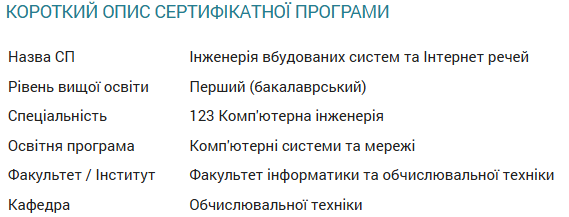
Certificate Program “Embedded Systems Engineering and Internet of Things” for the first (Bachelor’s) level of higher education under the Educational and Professional Program “Computer Systems and Networks” in specialty 123 “Computer Engineering.” Order number NОН/257/2022 dated 19.09.2022.
Demonstration of Laboratory Work:
Objective of the Certificate Program
Relevance of Launching the Certificate Program
Uniqueness of the Certificate Program
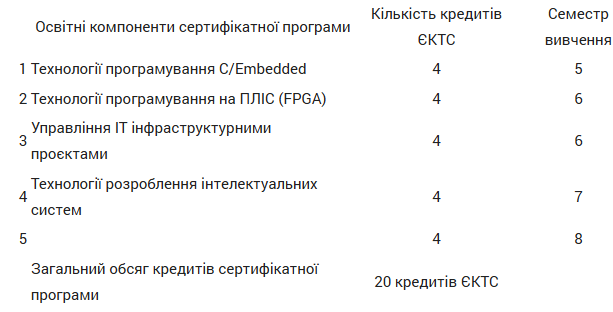
List of Educational Components of the Certificate Program
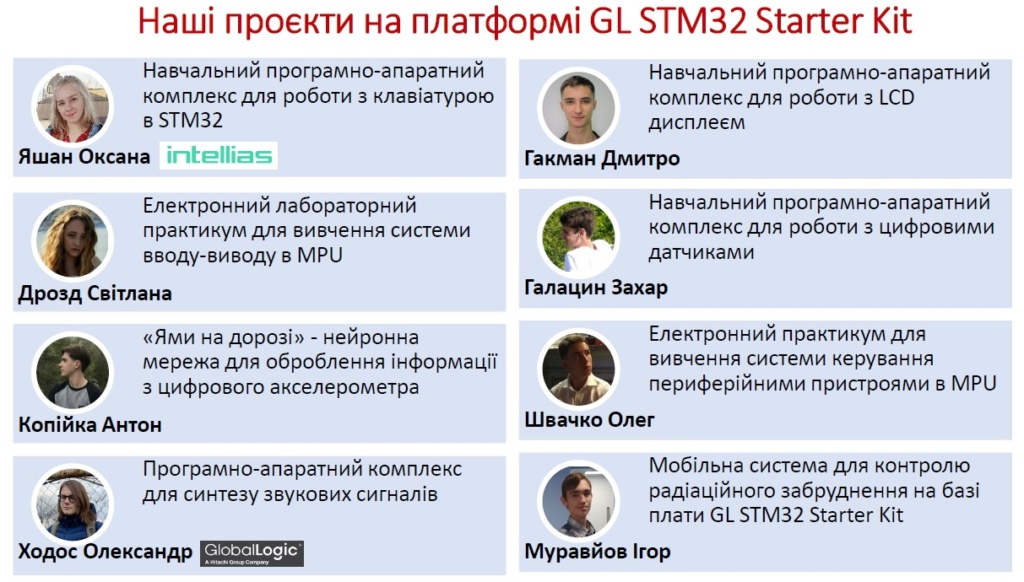
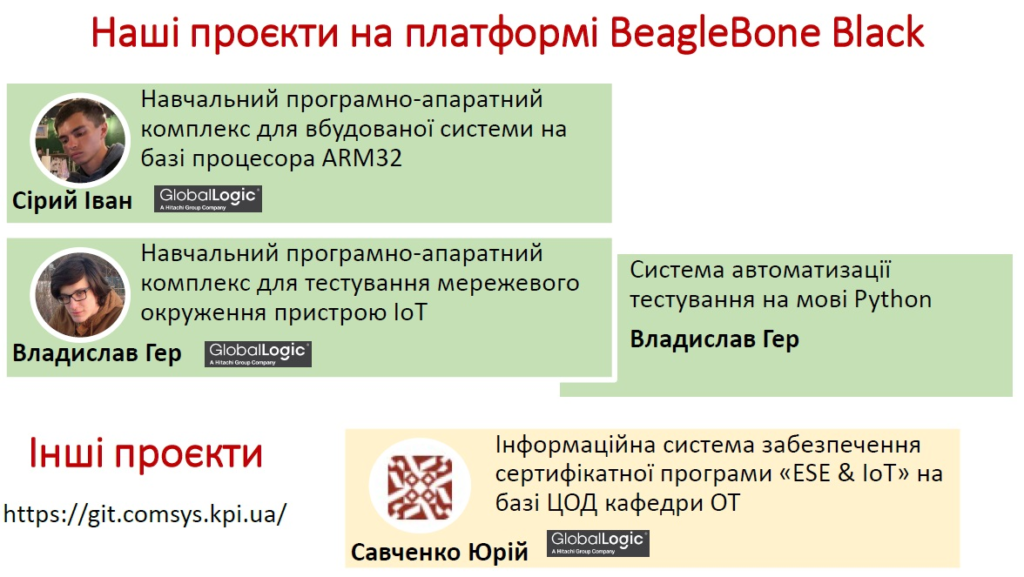
Our Projects (Bachelor’s Thesis Projects and Master’s Theses)
Presentation of the Certificate Program
Objective of the Certificate Program
The objective of the certificate program is to provide professional training for specialists in embedded systems engineering and the Internet of Things. The program ensures comprehensive coverage of technologies for developing embedded systems and their integration into IoT infrastructure, as well as the acquisition of knowledge and skills in using modern tools for embedded systems development and understanding current technological trends. The program is designed to equip students with a broad, versatile set of competencies combined with industrial input and the requirements of IT employer companies.
One of the key intentions of the certificate program is to help students thoroughly explore emerging markets, technological trends, applications, and the skills required for engineers seeking career development in the field of embedded systems and the Internet of Things, as well as to overcome the high entry barrier to this area of technology.
Relevance of Launching the Certificate Program
Today, the use of embedded systems is ubiquitous and continues to expand. Embedded systems are an integral part of the modern IT world and are increasingly integrated into the Internet of Things (IoT) and the Internet of Everything (IoE). Commercial, governmental, military, medical, educational, cultural, and other infrastructures are now connected into a unified IoT network and represent a conglomerate of both autonomous and interconnected embedded and intelligent systems.
Thus, the rapid development of modern IoT technologies requires appropriate specialized knowledge and skills from contemporary professionals in computer engineering, programming, and information systems in general. The certificate program is aimed at forming this system of specialized theoretical knowledge and practical skills.
The certificate program is designed to enhance the level of professional competencies in specialty 123 “Computer Engineering” and to strengthen professional training within the educational and professional program “Computer Engineering.” In particular, it focuses on mastering the theoretical and applied foundations of embedded systems development and their use within IoT infrastructure.
The program includes a strong hardware-oriented component, such as the design and development of sensor and actuator systems and their network environments. At the same time, students acquire essential knowledge and skills across different levels of IoT infrastructure, including data exchange between IoT devices and processing servers, edge computing architectures, and cloud-based IoT data analytics infrastructure.
The field of application of the knowledge and skills gained in this certificate program includes the development of solutions for the Internet of Things (IoT), embedded systems, and intelligent systems, in particular for the automotive industry, industrial automation, high-performance computing, artificial intelligence, and machine learning, aligned with advanced national and international practices.
Uniqueness of the Certificate Program
The certificate program was introduced as a profiling component of the Educational Program “Computer Engineering” to meet the educational needs of students by enabling them to form an individual learning trajectory within higher education.
The uniqueness of the certificate program lies in the fact that professionals from employer companies are continuously involved in teaching its disciplines. In particular, a certified QA Engineer participates in delivering lecture materials, while mentors and trainers from GlobalLogic are engaged in both lectures and laboratory classes. This collaboration aims to increase students’ confidence during job interviews and, overall, to enhance their competitiveness in the job market. From the perspective of IT companies, the program helps form the necessary knowledge and skills that meet employer requirements.
The certificate program includes unique content and author-developed courses created in cooperation with employer companies in the field of embedded systems and Internet of Things development. These courses are characterized by their practical orientation and relevance. Completing them provides students with additional knowledge and skills and expands their career opportunities in embedded systems engineering and IoT.
In particular, one of the author-developed courses provides specialized training for QA engineers for large IT companies where strong emphasis is placed on product quality. This is especially relevant for ensuring the safety of embedded systems and their critical applications, such as medical equipment, railway systems, aviation, and the transport industry. To prepare QA specialists in embedded systems, the course provides essential domain-specific knowledge in embedded system design and operation as well as computer networks. The foundational QA knowledge obtained can also be applied in software testing and serve as a basis for independent preparation for ISTQB certification.
The experience and practical skills gained within the certificate program are sufficient for students to continue independent professional development in the field of IoT devices and embedded systems using any available hardware and software tools on the market. The acquired foundational knowledge supports further self-learning and professional growth. The experience, knowledge, and practice obtained are sufficient to successfully pass interviews in IT companies engaged in embedded systems and IoT development.
Classroom activities of the certificate program are planned to be conducted in the Laboratory of Computer Systems Architecture and Microprocessor Technology (lab 535-18) at the Department of Computer Engineering. The laboratory is traditionally focused on hardware development for computer systems and is equipped with modern training equipment, including development boards with AVR microcontrollers, Arduino kits, sensor sets, and other components used for studying the fundamentals of embedded systems programming.
For laboratory work in the course “FPGA Programming Technologies (Field-Programmable Gate Arrays),” development boards from Intel (Altera) are used, including DE2 Board (Cyclone II), DE10 Standard Board (Cyclone IV), and DE1 SoC Board (Cyclone V), as well as free CAD tools such as ModelSim Mentor Graphics and Quartus II.
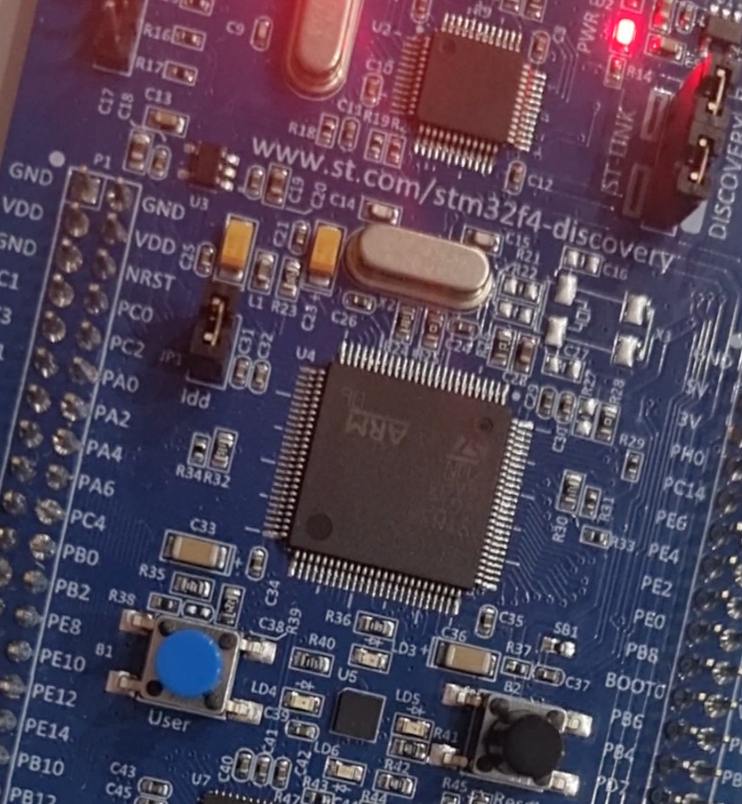
According to the cooperation agreement between Igor Sikorsky KPI and GlobalLogic Ukraine, training boards for STM StarterKit GlobalLogic and BeagleBone Black have been provided to support the certificate program and are used for the main cycles of laboratory work.
All educational materials and hardware-software tools are adapted for online use. Free CAD tools, emulators, and open-source software are used for verification and debugging of developed projects.
The educational and methodological support of the certificate program represents a комплекс consisting of electronic textbooks for each discipline, online courses hosted on the “Sikorsky” distance learning platform within Google Workspace for Education, and a methodological complex for laboratory work based on a collaborative project management system using GitLab.
The textbooks, in a set of five electronic editions, contain the necessary theoretical and practical material—both foundational and discipline-specific—as well as theoretical background and tasks for laboratory and modular control work. All textbooks were approved at the department meeting No. 10 dated 25.05.2022 and by the faculty methodological commission No. 10 dated 09.06.2022 (documents were being prepared for university approval in August 2022 for the autumn semester of the third year and in September 2022 for subsequent semesters).
The online courses with video lectures and laboratory assignments, including support for asynchronous and online learning modes, are available on the “Sikorsky” distance learning platform within Google Workspace for Education.
The human resource capacity of the department for supporting the certificate program disciplines meets the licensing requirements for educational activities. The teaching staff includes:
Iryna A. Klymenko, Doctor of Technical Sciences, Associate Professor, Professor of the Department of Computer Engineering;
Valentyna V. Tkachenko, PhD in Technical Sciences, Associate Professor of the Department of Computer Engineering;
Artem V. Kaplunov, Assistant Lecturer at the Department of Computer Engineering, graduate of the university PhD program (defense of dissertation is planned for the 2022–2023 academic year).
All lecturers involved in the certificate program are faculty members of the Department of Computer Engineering with extensive teaching experience in the field of Computer Engineering. They are authors of textbooks, have published scientific papers in specialized journals (including international indexed publications), hold patents for inventions and utility models, and participate in research projects related to the program disciplines.
Viktoriia A. Taraniuk, a certified QA Engineer at GlobalLogic Ukraine since 2019, has been involved in teaching both compulsory and elective courses at the Department of Computer Engineering under the cooperation agreement between Igor Sikorsky KPI and GlobalLogic Ukraine. In the 2021–2022 academic year, she also worked as a part-time assistant at the department. She is one of the developers of the certificate program and the author of the course “Testing and Quality Assurance (QA) of Embedded Systems” on the “Sikorsky” distance learning platform within Google Workspace for Education, as well as of related textbooks. She is also an author of scientific articles and conference presentations.
GlobalLogic company mentors are and will continue to be involved in teaching activities throughout the semester.
Iryna A. Klymenko, Doctor of Technical Sciences, Associate Professor, Professor at the Department of Computer Engineering;
Valentyna V. Tkachenko, PhD in Technical Sciences, Associate Professor, Associate Professor at the Department of Computer Engineering;
Artem V. Kaplunov, Assistant at the Department of Computer Engineering, graduate of the University PhD program (defense of dissertation is planned for the 2022–2023 academic year);
Viktoriia A. Taraniuk, Assistant at the Department of Computer Engineering (in the 2021–2022 academic year, part-time), QA Engineer at GlobalLogic Ukraine;
Vitalii Y. Horodetskyi, Software Engineer at GlobalLogic Ukraine.
List of Educational Components of the Certificate Program
Our Projects (Bachelor’s Thesis Projects and Master’s Theses)
Architectural concept of automated assignment checking in a remote Gitea repository
System for automating laboratory work assessment based on Gitea
Mobile application for road surface quality visualization for Smart City systems
Tools for remote development and debugging of embedded systems
Remote project-based learning system based on Gitea
Experimental setup for remote development of an embedded system using STM Discovery board
A set of artifacts for integration testing of an information system
Educational system for collaborative IT project execution based on CI/CD methodology
Automated system for laboratory assignment checking in the C/Embedded course
Projects from Previous Years